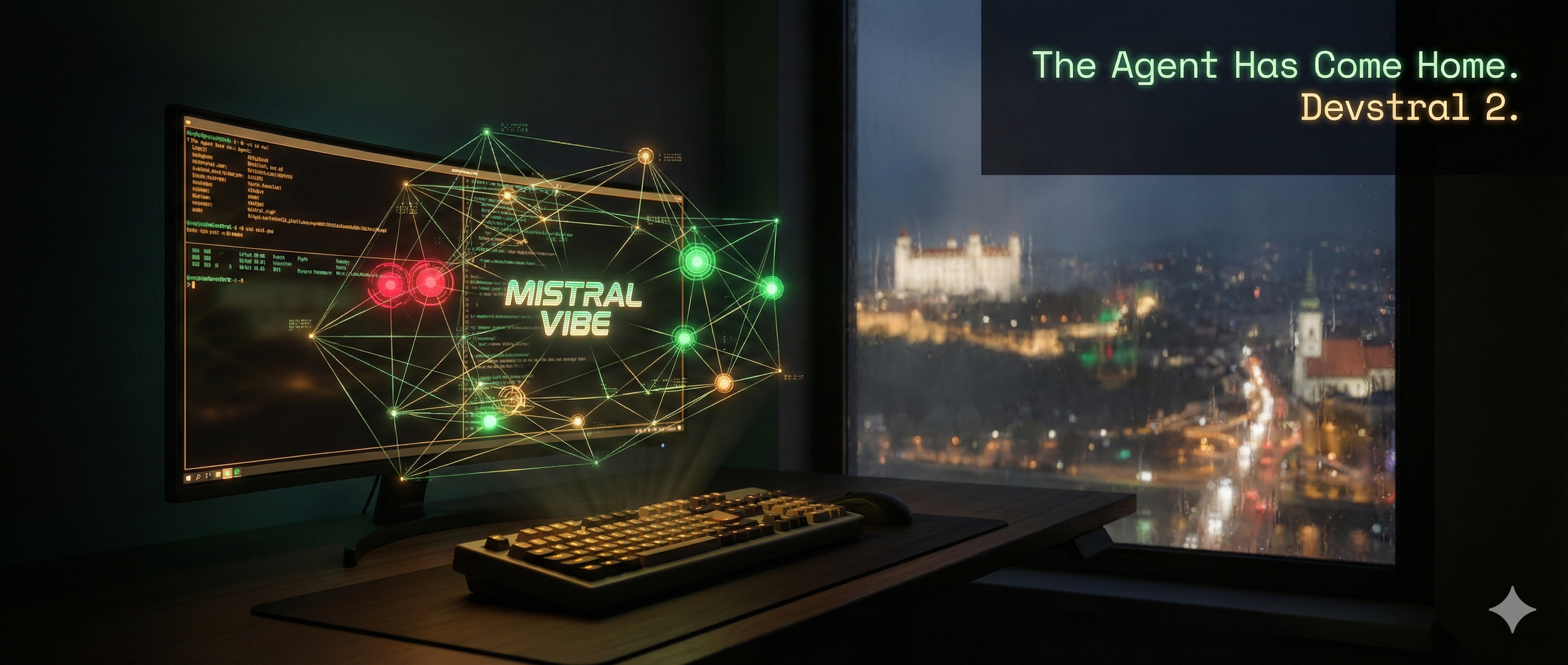
Paris-based Mistral AI has released Devstral 2, a “dense” coding model family designed to challenge Silicon Valley dominance through “vibe coding” and aggressive pricing. Yet, as the company navigates complex licensing controversies and Chinese competition, the launch represents a pivotal shift from code generation to autonomous orchestration.
The rain against the windowpane of the apartment in Bratislava had not ceased since Tuesday, a relentless, grey drumbeat that matched the rhythm of Jakub’s headache. He was forty-two—old enough to remember when deploying a server meant physically racking hardware in a freezing basement, and certainly senior enough to be responsible for a Python repository that had accumulated a decade of technical debt. His terminal was a clutter of error logs and failed build attempts. Like thousands of his peers, Jakub suffered from a specific modern ailment: AI fatigue. He had subscribed to Copilot, dabbled with Cursor, and tested Gemini, yet here he was, still manually wrestling with dependency hell at 2:00 AM. When the notification flashed across his screen—another launch, another model, this time from Paris—he almost swiped it away. “Devstral 2,” the headline read. “Vibe Coding.” He exhaled, a sound sharp with cynicism, and typed the installation command for the mistral-vibe CLI, expecting nothing more than another colorful way to be disappointed.
The Architectural Gamble
Jakub’s skepticism was well-founded, for Mistral AI’s December 9, 2025, release of the Devstral 2 family was not a solitary shout in the dark, but a chorus joining a deafening roar. The artificial intelligence landscape has become crowded to the point of claustrophobia, populated by the giants of Silicon Valley and the rapid iterators of Shenzhen. Yet, as the installation bar filled, the distinct ambition of this French laboratory began to clarify. They were not trying to replace the Integrated Development Environment (IDE) where developers like Jakub spent their days; they were attempting to reclaim the terminal. The launch introduced two dense transformer models—the massive 123-billion parameter Devstral 2 and the nimble 24-billion parameter Devstral Small 2—paired with a new interface philosophy that treats the command line not as a place for syntax, but as a seat for orchestration.
The defining characteristic of this new entry is its architectural stubbornness. While the industry has largely pivoted to “Mixture-of-Experts” (MoE) models to save compute, Mistral adhered to a “dense” architecture for its flagship, ensuring every parameter is active during inference. This 123B model, designed for enterprise-grade reasoning, claims a 72.2% score on SWE-bench Verified, a metric that evaluates the ability to solve real-world GitHub issues. It is a respectable number, placing it within striking distance of proprietary leaders like Anthropic’s Claude Sonnet 4.5, yet it remains statistically behind the 73.1% benchmark set by its primary geopolitical rival, the Chinese open-weight model DeepSeek V3.2. The distinction here is less about raw supremacy and more about the democratization of capability; the smaller 24B model, released under a permissive Apache 2.0 license, allows a developer to run a near-senior-level engineer locally on a high-end consumer GPU, effectively bringing the “agent” home from the cloud.
The Economics of Syntax
For the developer weary of subscription drain, Mistral’s pitch is starkly economic. The company claims Devstral 2 is “7x more cost-efficient” than its American counterparts, a figure derived from an aggressive pricing strategy of $0.40 per million input tokens. In the “read-heavy” workflows of agentic coding—where an AI must ingest thousands of lines of documentation and git history before writing a single function—this subsidy is critical. The model’s 256,000-token context window is designed to hold an entire project in working memory, allowing the Vibe CLI to scan file structures and “understand” the repository state without manual file attachment. It is a move to commoditize the “reading” of code, betting that accessibility will trump the marginal IQ advantages of more expensive, closed models.
The Licensing Schism
However, the narrative of “openness” that Mistral cultivates is fractured by legal reality. While the smaller model is truly open, the flagship Devstral 2 is governed by a “Modified MIT” license, a legal instrument that acts as a gatekeeper. It introduces a revenue ceiling: any entity generating more than $20 million in monthly revenue is barred from using the model freely and must negotiate a commercial license. This “poison pill” targets the hyperscalers—Amazon, Google, Microsoft—preventing them from simply wrapping the model and selling it as a service, a tactic that reveals the tension between altruistic open-source ideals and the brutal necessity of commercial survival.
Back in the dim light of his apartment, Jakub watched the Vibe agent work. He had typed a natural language instruction—“Refactor the authentication module to handle the new OAuth tokens and update the tests”—and stepped back. The cursor did not just spit out code; it queried the file structure, read the relevant auth.py, planned the edit, and executed the changes across three different files. It was not perfect; the latency was noticeable, and he would still have to review the logic. But as the terminal flashed green, signaling a successful test run, the knot of fatigue in his chest loosened. It was, in the end, just another tool in a long line of tools. It had not reinvented the wheel, nor had it rendered him obsolete. But as he closed his laptop and listened to the rain finally slow to a stop, Jakub realized it had bought him something more valuable than efficiency: it had bought him sleep.