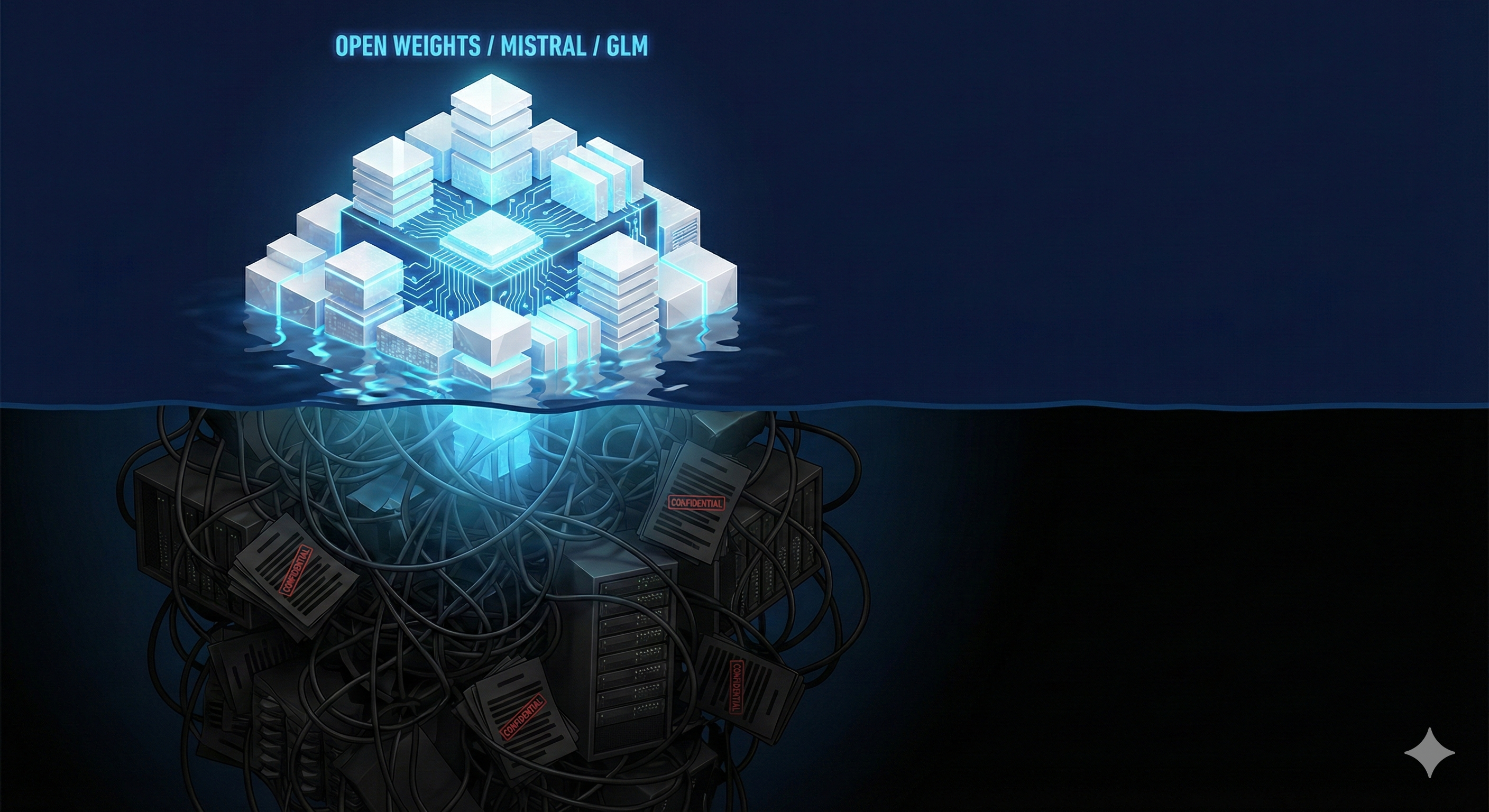
In a single week, the release of Mistral Large 3 and GLM-4.6V shattered the assumption that frontier AI is the exclusive domain of Silicon Valley giants. Yet, as a new research paper reveals, the shift toward a multipolar AI order comes with a hidden price tag: while model weights are opening up, the data behind them is going dark.
Elias sat in the blue glow of his monitor in a cramped Zurich apartment, watching a cursor blink. For three years, he had built his livelihood by renting intelligence from servers in California, paying a fraction of a cent for every thought he asked a proprietary API to complete. He was a tenant in the house of big tech. But tonight, the dynamic had inverted. On his screen, a local script was executing complex code generation, fueled not by a distant cloud but by a new 14-billion parameter model running entirely on his own hardware. It was fast, it was private, and for the first time, it belonged to him. Elias was witnessing the aftershocks of a week that future historians of technology may record as a definitive inflection point in the trajectory of artificial intelligence.
A Week of Tremors
In a span of six days in early December 2025, the global ecosystem witnessed two monumental releases that fundamentally altered the competitive landscape. The first tremor originated in Paris on December 2 with Mistral AI’s deployment of Mistral Large 3, a sparse Mixture-of-Experts model boasting a staggering 675 billion parameters. By utilizing a sophisticated architecture that activates only 41 billion parameters per token, Mistral achieved a decoupling of knowledge from compute, allowing the model to claim parity with proprietary systems on select benchmarks like MMLU, while remaining efficient enough for optimized infrastructure. Released under the permissive Apache 2.0 license, it signaled a maturation of the “open weights” paradigm, challenging the dominance of closed-source frontier labs.
Before the industry could fully digest the implications of the European release, a second shockwave arrived from Beijing on December 8. Zhipu AI released GLM-4.6V, a 106-billion parameter multimodal model that dismantled the barrier between vision and action. Unlike previous iterations that relied on text descriptions to interact with the world, GLM-4.6V introduced native tool-calling capabilities, allowing the model to “see” a visual interface and “act” directly through function execution. By releasing this capability under the MIT license, Zhipu AI effectively commoditized the agentic workflow, bypassing the text-based intermediation that had previously ring-fenced such power within closed providers like OpenAI and Google.
The Structural Realignment
These twin releases served as the practical validation for a structural shift quantified in the research paper Economies of Open Intelligence, published just days earlier in late November. This rigorous analysis of 2.2 billion model downloads and 851,000 models confirmed that the hegemony of US-based industry players in the open ecosystem is eroding. In its place, a multipolar order is emerging, characterized by the explosive growth of Chinese industry players and unaffiliated community developers. However, this new era is marked by a “transparency recession,” where the release of open weights is accompanied by a sharp decline in the disclosure of training datasets—dropping from 79% to 39% since 2022—leaving the ecosystem powerful but increasingly opaque.
The True Cost of Independence
Back in Zurich, the fan on Elias’s laptop whirred into a higher register as he pushed the model to its limits. He paused, realizing the irony of his newfound independence. While he could run the 14-billion parameter “Ministral” variant on his desk, the flagship 675-billion parameter model required a cluster of 3,000 NVIDIA H200 GPUs to train and a massive multi-GPU node to run. The barrier to entry had not been removed; it had merely shifted from intellectual property to capital expenditure. Elias looked at the code streaming across his screen, understanding that while the weights were now free, the silence of the room was deceptive; the true cost of this open intelligence was now measured in the deafening roar of industrial cooling fans he could never afford to house.