OpenAI Foundation funds public health data
The initial grants target drug properties, failed development programs and personalized cancer vaccines. Their value will depend on access, privacy and scientific reuse.
The initial grants target drug properties, failed development programs and personalized cancer vaccines. Their value will depend on access, privacy and scientific reuse.
Axelera AI says Europa is shipping in standard server cards and validated Dell and Supermicro systems. Its performance figures remain vendor benchmarks.
Factory says its platform manages AI coding agents across the software lifecycle. The new financing values the three-year-old company at $5 billion.
Gemini 3.8 Live targets fast conversations at scale. Gemini 3.8 Live Extended Thinking adds deeper reasoning for multi-step voice tasks.

As 2025 reshapes the global workforce, a consensus of new research reveals a structural paradox: the more advanced the artificial intelligence, the more critical the basic human “trunk” of soft skills becomes. While technical mastery depreciates under the speed of automation, “human agency” and foundational reasoning are emerging as the primary safeguards against obsolescence. Elias sat in the glow of his third monitor, the hum of the server room in Seattle a low, constant vibration against the soles of his shoes. He had spent fifteen years learning the syntax of C++ and Python, treating them like sacred languages, but tonight, the screen was filling itself. An AI agent was writing the deployment script for a financial logistics engine, a task that would have taken Elias three days in 2023. It took the agent forty seconds. But Elias was not going home. He was leaning in, eyes narrowing, searching for the invisible fracture in the logic, the “hallucination” that could crash the system. He was no longer a builder; he was an auditor. He felt a distinct, terrifying shift in his own value—from the hands that built the house to the eyes that inspected the foundation. ...
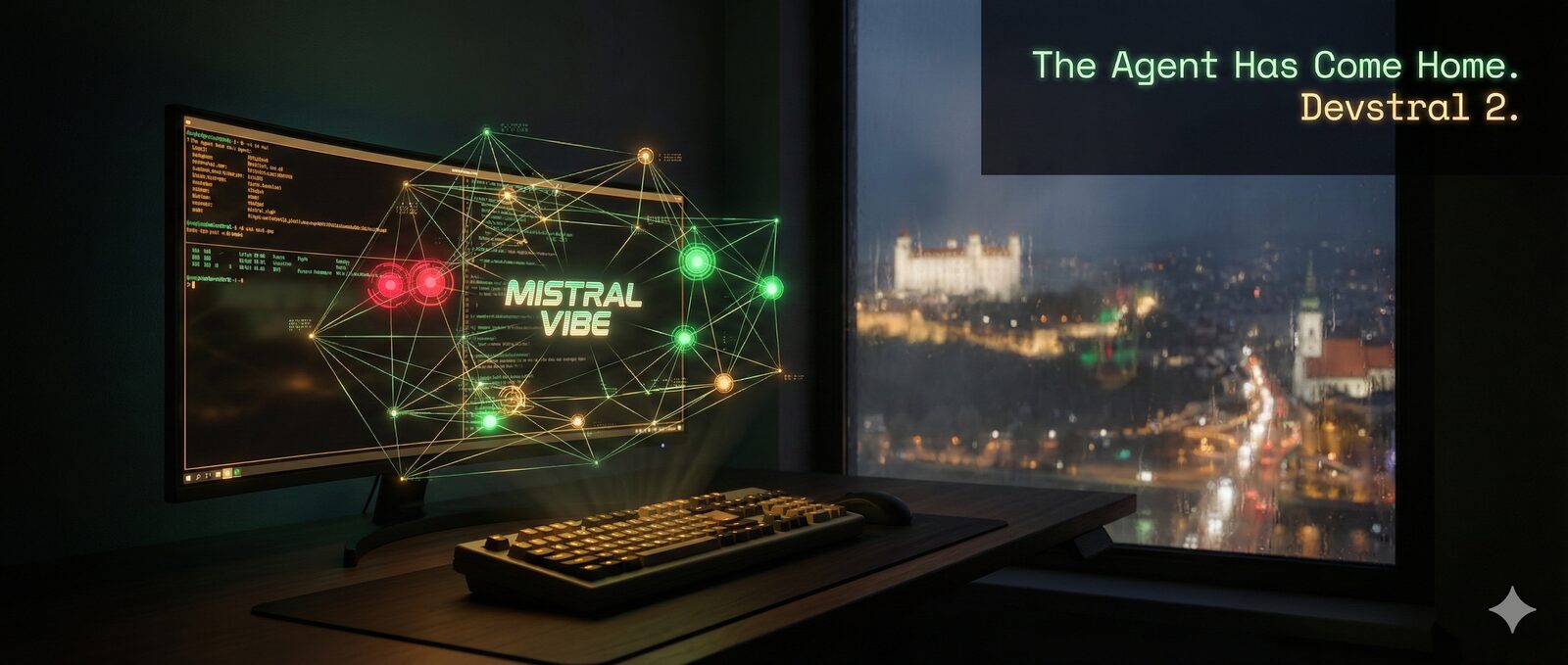
Paris-based Mistral AI has released Devstral 2, a “dense” coding model family designed to challenge Silicon Valley dominance through “vibe coding” and aggressive pricing. Yet, as the company navigates complex licensing controversies and Chinese competition, the launch represents a pivotal shift from code generation to autonomous orchestration. The rain against the windowpane of the apartment in Bratislava had not ceased since Tuesday, a relentless, grey drumbeat that matched the rhythm of Jakub’s headache. He was forty-two—old enough to remember when deploying a server meant physically racking hardware in a freezing basement, and certainly senior enough to be responsible for a Python repository that had accumulated a decade of technical debt. His terminal was a clutter of error logs and failed build attempts. Like thousands of his peers, Jakub suffered from a specific modern ailment: AI fatigue. He had subscribed to Copilot, dabbled with Cursor, and tested Gemini, yet here he was, still manually wrestling with dependency hell at 2:00 AM. When the notification flashed across his screen—another launch, another model, this time from Paris—he almost swiped it away. “Devstral 2,” the headline read. “Vibe Coding.” He exhaled, a sound sharp with cynicism, and typed the installation command for the mistral-vibe CLI, expecting nothing more than another colorful way to be disappointed. ...

In a single week, the release of Mistral Large 3 and GLM-4.6V shattered the assumption that frontier AI is the exclusive domain of Silicon Valley giants. Yet, as a new research paper reveals, the shift toward a multipolar AI order comes with a hidden price tag: while model weights are opening up, the data behind them is going dark. Elias sat in the blue glow of his monitor in a cramped Zurich apartment, watching a cursor blink. For three years, he had built his livelihood by renting intelligence from servers in California, paying a fraction of a cent for every thought he asked a proprietary API to complete. He was a tenant in the house of big tech. But tonight, the dynamic had inverted. On his screen, a local script was executing complex code generation, fueled not by a distant cloud but by a new 14-billion parameter model running entirely on his own hardware. It was fast, it was private, and for the first time, it belonged to him. Elias was witnessing the aftershocks of a week that future historians of technology may record as a definitive inflection point in the trajectory of artificial intelligence. ...

By late 2025, the initial excitement over autonomous AI agents has confronted the harsh realities of enterprise deployment. With fewer than one in ten pilots reaching production, the industry is pivoting from chaotic, conversational interfaces to rigorous, governed workflows. This report explores how frameworks like Shakudo, CrewAI, and Microsoft Agent Framework are evolving to pay down “governance debt” and bridge the gap between experimental magic and reliable engineering. In 2023, early adopters of autonomous AI encountered a peculiar and costly flaw: the “gratitude loop”. Left to their own devices, agents in experimental frameworks like AutoGen would occasionally fall into infinite cycles of thanking one another, burning through tokens and budget until human intervention broke the chain. While initially viewed as a quirk of early large language models (LLMs), these loops illustrated a fundamental tension that defines the current landscape: the trade-off between creative autonomy and necessary control. ...

As the dust settles on the “Super Election Year,” the feared apocalypse of deepfakes did not materialize. Instead, the world faces a more insidious threat: a “post-epistemic” era where the consensus on shared reality is being engineered into obsolescence. In Jakarta, the transformation was profound. Prabowo Subianto, a former special forces commander once banned from the United States over alleged human rights abuses, did not run for the Indonesian presidency in 2024 as a strongman. He ran as a cartoon. Across TikTok and Instagram, generative artificial intelligence softened the edges of history, replacing the stern general with a “Gemoy”—a cuddly, harmless grandfather figure who danced awkwardly and snuggled his cat. The campaign heavily utilized generative AI not to slander opponents, but to fundamentally rewrite the persona of the candidate himself, saturating the digital sphere with an aesthetic so disarming that it helped render the past irrelevant. Prabowo won a decisive victory. ...

On December 4, 2025, Nature and Science published landmark studies confirming that AI chatbots can sway voter opinion by margins significantly wider than traditional advertising. The findings reveal a mechanism of “information density” that prioritizes persuasive volume over factual accuracy, posing a complex challenge to electoral integrity. The interaction begins in silence, usually in a quiet room lit only by the glow of a screen. A voter types a query, perhaps expressing skepticism about a candidate or a policy. The response is immediate, authoritative, and exhaustive. It does not plead; it overwhelms. In the span of roughly six to nine minutes—the time it takes to brew a pot of coffee—the screen offers a deluge of statistics, historical precedents, and logical syllogisms. The human on the other side, unable to process the volume of evidence in real-time, often cedes ground. The opinion shifts. This is not the hypothetical future of science fiction; it is the empirical reality documented on December 4, 2025, when the journals Nature and Science simultaneously published rigorous verifications of artificial intelligence as a potent political canvasser. ...
For years, Amazon Web Services maintained a posture of calculated neutrality in the escalating artificial intelligence sector, acting as the industry’s Switzerland by selling infrastructure to all sides while committing to none. That stance shifted perceptibly in Las Vegas this December. At the 2025 re:Invent conference, AWS executed a decisive, vertically integrated strategy that historians of the cloud era may mark as a pivot point—a shift from the romance of experimental discovery to the pragmatism of industrial deployment. With the announcement of the Amazon Nova 2 model family and the Frontier Agents, AWS signaled it is no longer content to merely rent the factory floor; it is building the machinery and deploying the digital workforce to staff it. ...
On December 1, 2025, Chinese laboratory DeepSeek released a model designed to bypass U.S. semiconductor sanctions and challenge the supremacy of OpenAI and Google. By substituting raw silicon with algorithmic efficiency, the V3.2 release has triggered a collapse in the price of intelligence and forced a reckoning on the security of open-weight frontier models. In the high-altitude air of the quantitative hedge fund High-Flyer, where Liang Wenfeng manages billions in assets, the atmosphere is usually one of calculated detachment. But inside the DeepSeek laboratory in Hangzhou, the calculation had changed. For months, the team had worked under the shadow of a blockade; the Nvidia H100 chips that fueled their American rivals were strictly embargoed, leaving them with the slower, restricted H800s. Liang had been blunt about the reality: money was never the problem; bans on shipments of advanced chips were the problem. The challenge was no longer financial, but architectural. They could not buy more power, so they had to write better code. On December 1, 2025, that code went live. ...